Mobility Scooter Rules in Australia 2026
A State-by-State Guide
Mobility scooters can provide greater independence and make everyday travel easier for people who have difficulty walking. However, if you use a mobility scooter in public in Australia, it is important to understand the rules that apply in your state or territory.
Although mobility scooter users are generally treated similarly to pedestrians when their device meets the applicable requirements, the rules are not identical across Australia. Requirements relating to speed, registration, scooter weight and where a mobility scooter can be used can vary between jurisdictions.
This guide provides an overview of mobility scooter rules in Australia in 2026 and highlights some important differences between states and territories.
Important: This article provides general information only and is not legal advice. Road rules and mobility-device requirements can change. Always check your state or territory transport authority for the latest requirements.
Are Mobility Scooters Considered Motor Vehicles in Australia?
There is no single rule that should be applied to every mobility scooter throughout Australia.
In many Australian jurisdictions, a person using an eligible mobility scooter or motorised wheelchair is treated as a pedestrian for road-rule purposes.
A key requirement in several jurisdictions is that the device must not be capable of travelling faster than 10 km/h.
However, other requirements can differ between states and territories, including:
- Who may use the device
- Maximum device weight
- Whether registration is required
- Where the device may travel
- What happens if the scooter is capable of travelling faster than 10 km/h
For this reason, mobility scooter users should check the rules applying specifically in their state or territory.
Where Can You Use a Mobility Scooter?
Where a mobility scooter user has pedestrian status, the general principle is that they should follow the road rules applying to pedestrians.
Depending on the jurisdiction, this generally means using:
- Footpaths and nature strips where available
- Pedestrian crossings and traffic lights when crossing roads
- Appropriate shared paths where permitted
- The side of a road where there is no suitable footpath, subject to the applicable road rules
Users should take care around other pedestrians and avoid creating an obstruction or traffic hazard.
The exact rules vary by jurisdiction, so do not assume that permission to use a mobility scooter in one location means the same rules apply everywhere in Australia.
Mobility Scooter Speed Limits
The 10 km/h threshold is particularly important for mobility scooters and powered wheelchairs in Australia.
For example, NSW treats eligible mobility scooter and motorised wheelchair users as pedestrians, with devices used on footpaths required to be unable to travel faster than 10 km/h.
Western Australia similarly treats motorised wheelchairs and mobility scooters limited to 10 km/h as pedestrian mobility aids.
A scooter capable of travelling faster than this may be treated differently under the law. Therefore, users should check the specifications of their device as well as their local rules.
Even where a scooter can legally travel at up to 10 km/h, users should select an appropriate speed for the environment and take particular care in busy pedestrian areas.
Mobility Scooter Rules by State and Territory
Victoria
In Victoria, mobility scooters and powered wheelchairs are referred to as motorised mobility devices.
Transport Victoria advises that these devices are intended for people who have difficulty walking. Users should understand the road rules applying to where and how their device can be operated.
When travelling in pedestrian environments, mobility scooter users should operate carefully around other people and choose a device suitable for their individual needs and intended environment.
Because mobility scooters are different from recreational scooters and e-scooters, users should not rely on e-scooter rules when determining how a mobility device may be used.
For the latest requirements, check Transport Victoria’s guidance for motorised mobility devices.
New South Wales
In NSW, people with a disability who cannot walk or who have difficulty walking may use mobility scooters or motorised wheelchairs.
Eligible users are treated as pedestrians and must follow pedestrian road rules.
For use on footpaths, the device must not be capable of travelling faster than 10 km/h.
Motorised wheelchairs and other eligible mobility devices are exempt from vehicle registration when they are:
- Used solely to transport a person whose disability substantially impairs their mobility; and
- Unable to travel faster than 10 km/h
A driver licence is not required for an eligible motorised wheelchair.
Users should normally use footpaths where available. Where there is no suitable footpath, pedestrian road rules determine how the road may be used.
Queensland
Queensland has an important registration requirement that differs from many other Australian jurisdictions.
If a motorised mobility device is used on a footpath or road-related area in Queensland, it must generally be registered. Registration is currently free.
A Queensland mobility scooter that qualifies for registration must:
- Be built to transport a person who is unable to walk or has difficulty walking
- Have an electric motor
- Be steered using handlebars or a steering wheel
- Not be capable of exceeding 15 km/h on level ground
- Have an unladen mass of no more than 170 kg
Devices over 170 kg cannot ordinarily be registered as mobility scooters, although a special circumstances permit may be available.
When operating a motorised mobility device, users must travel at no more than 10 km/h and generally use a footpath or nature strip. If these are unsuitable, Queensland provides rules for travelling near the side of the road.
There is no minimum age requirement for registration, but the person controlling the device must be capable of operating it safely.
Visitors to Queensland are exempt from the Queensland registration requirement, while people who move to Queensland to live must generally register their device within the required period.
South Australia
South Australia refers to mobility scooters, gophers and similar devices within its rules for motorised wheelchairs.
A motorised wheelchair that cannot travel faster than 10 km/h, and is being used by someone who is unable to walk or has difficulty walking, is treated as a pedestrian under the applicable road rules.
Users therefore need to follow pedestrian rules, including using a footpath or nature strip where available and crossing roads safely.
South Australia also has additional rules for devices capable of travelling faster than 10 km/h. For example, certain devices may only be used on a footpath when they are travelling at no more than 10 km/h, meet applicable weight requirements and are being used by a person with a reasonable mobility need.
Users should check SA Government requirements for their particular scooter before using it in public.
Western Australia
In Western Australia, motorised wheelchairs and mobility scooters limited to a top speed of 10 km/h are treated as pedestrian mobility aids. For these devices:
- A driver’s licence is not required
- Vehicle registration is not required
- Users have pedestrian status and must follow the relevant pedestrian rules
However, a mobility scooter or motorised wheelchair capable of travelling faster than 10 km/h loses pedestrian status and can be treated as a road-going vehicle.
This can introduce vehicle licensing and other requirements and may make the device unsuitable for lawful public-road use unless it complies with the applicable vehicle requirements.
Tasmania
Tasmania has its own specific rules, which is why a single Australia-wide scooter weight limit should not be quoted.
Under Tasmania’s current road rules, a motorised wheelchair may be driven on a path where:
- Its unladen mass does not exceed 150 kg
- It is not travelling faster than 10 km/h
- The user’s physical condition gives them a reasonable need to use the wheelchair
Users on paths must also comply with applicable give-way requirements.
This differs from weight limits used in some other jurisdictions and demonstrates why users should always check their state’s rules.
Northern Territory
In the Northern Territory, a person using a motorised wheelchair that cannot travel faster than 10 km/h is treated as a pedestrian.
This means users generally have the same rights and responsibilities as other pedestrians.
Pedestrian rules include using footpaths and nature strips where provided and, where these cannot be used, keeping to the appropriate side of the road and following applicable pedestrian safety requirements.
Users should check current NT Government road rules before travelling in public.
Australian Capital Territory
The ACT road-rule framework also recognises a person driving a qualifying motorised wheelchair as a pedestrian where the device cannot travel faster than 10 km/h on level ground.
As with other jurisdictions, users should follow the applicable pedestrian and road rules and check Access Canberra or current ACT legislation for any updated requirements.
Is There a Maximum Weight for Mobility Scooters in Australia?
There is not one maximum weight that should be quoted as applying to every mobility scooter throughout Australia.
Weight requirements differ between jurisdictions and can also depend on how and where a device is being used. For example:
- Queensland’s registrable mobility scooter definition includes an unladen mass limit of 170 kg
- Tasmania permits a motorised wheelchair on a path under its specific rule where the unladen mass is not over 150 kg
- South Australia has its own weight conditions for certain devices and situations
Before purchasing a scooter, check both the scooter specifications and the requirements applying in your state or territory.
Can You Ride a Mobility Scooter on the Road?
Mobility scooter users should generally use pedestrian facilities such as footpaths where the applicable rules require them to do so.
However, some jurisdictions permit a mobility scooter user to travel along the side of a road where a suitable footpath or nature strip is unavailable.
The rules about positioning, direction of travel and when road use is permitted differ between jurisdictions.
Therefore, it is safer to check your local road authority’s requirements rather than relying on a general Australia-wide rule.
Do You Need a Licence to Use a Mobility Scooter?
For qualifying mobility scooters and motorised wheelchairs that have pedestrian status, a driver’s licence is generally not required.
However, this should not be confused with registration of the mobility device.
For example, Queensland requires motorised mobility devices used on footpaths or road-related areas to be registered, even though registration is free.
Western Australia does not require vehicle registration or a driver’s licence for qualifying devices limited to 10 km/h.
Always check the requirements in your jurisdiction.
Mobility Scooter Safety Tips
Regardless of the legal requirements in your state, safe operation is essential. Before travelling:
- Check your brakes, tyres and battery
- Make sure you understand your scooter’s controls and speed settings
- Select a safe speed for your surroundings
- Slow down around pedestrians, entrances and busy shopping areas
- Use extra caution when crossing roads and driveways
- Make yourself visible in poor lighting conditions
- Avoid blocking footpaths, entrances and exits when parking
- Follow instructions from transport operators when using public transport
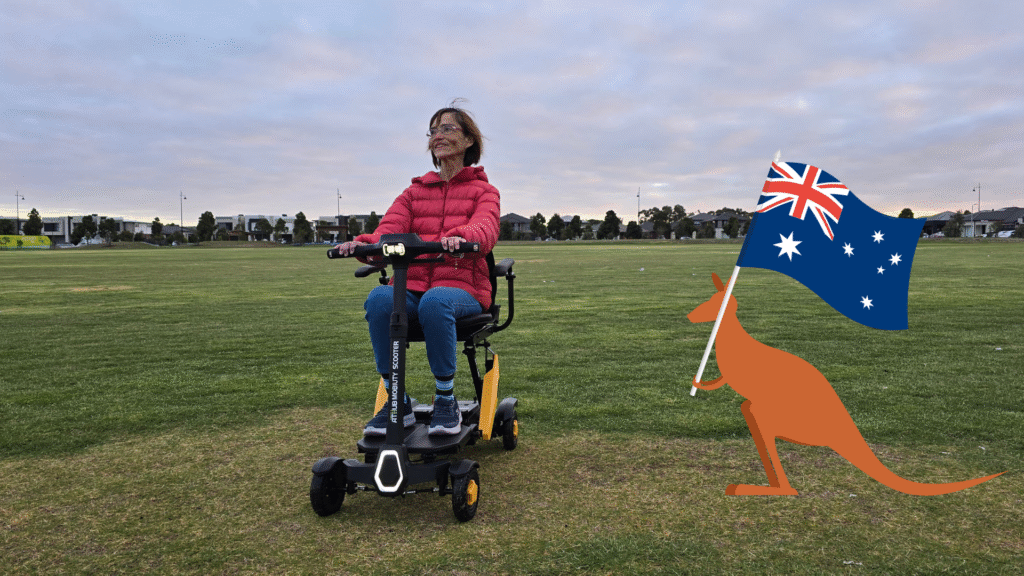
Visibility accessories such as flags, lights, reflectors and mirrors may also help improve safety where appropriate.
Can You Take a Mobility Scooter on Public Transport?
Mobility scooters can be accommodated on many Australian public transport services, but size, weight, manoeuvrability and accessibility requirements vary between operators and states.
A scooter that is legal to use on a footpath is not automatically guaranteed to fit or be accepted on every bus, train or tram.
Before travelling, check the accessibility requirements of the relevant public transport operator, particularly for:
- Maximum dimensions
- Combined scooter and user weight
- Ramp or boarding requirements
- Turning space
- Designated mobility areas
- Battery requirements
Choosing a Suitable Mobility Scooter
Legal requirements are only one consideration when choosing a mobility scooter. You should also consider:
- Your mobility and physical needs
- Where you intend to use the scooter
- Scooter dimensions and weight
- Maximum safe user weight
- Turning radius
- Battery range
- Terrain and gradients
- Portability and storage
- Public transport requirements
An occupational therapist or other appropriately qualified health professional can help determine which mobility solution is suitable for your circumstances.
Care With Us offers a range of mobility scooters and mobility accessories. Our team can provide product information and help you compare scooter specifications, but users should always confirm current legal requirements with their state or territory transport authority.
Frequently Asked Questions
Do I need a licence to drive a mobility scooter in Australia?
Generally, a driver’s licence is not required when a qualifying mobility scooter or motorised wheelchair is treated as a pedestrian mobility aid. However, the requirements vary between jurisdictions.
Do mobility scooters need to be registered?
It depends on the state or territory. Queensland requires motorised mobility devices used on footpaths or road-related areas to be registered, and registration is free. Other jurisdictions have different registration arrangements, so always check with your local transport authority.
What is the mobility scooter speed limit?
The 10 km/h threshold is important in several Australian jurisdictions. In many states and territories, pedestrian status depends on a device being unable to exceed 10 km/h or being operated at no more than 10 km/h. Queensland is a notable example where a registrable mobility scooter may be capable of up to 15 km/h, but users must not operate the device faster than 10 km/h.
Can I use my mobility scooter on the road?
Footpaths and other pedestrian facilities should generally be used where required and available. Some jurisdictions allow mobility scooter users to travel near the side of the road where a suitable footpath is unavailable or impractical. Check your state or territory’s rules before using a mobility scooter on a road.
Is there a 110 kg maximum weight for mobility scooters throughout Australia?
No. Do not rely on 110 kg as a universal Australian mobility scooter weight limit. Different jurisdictions have different requirements. For example, Tasmania has a 150 kg unladen-mass condition for the relevant path rule, while Queensland’s registrable mobility scooter definition allows an unladen mass of up to 170 kg.
Can I take a mobility scooter on public transport?
Often yes, but each transport network has accessibility requirements relating to dimensions, weight and manoeuvrability. Check with the relevant transport operator before travelling.
Final Thoughts
Mobility scooters can provide greater freedom and independence, but Australia’s rules are not completely uniform across every state and territory.
The most important points to remember are:
- Do not assume one national weight limit applies everywhere
- 10 km/h is an important threshold in many jurisdictions
- Qualifying users are commonly treated as pedestrians
- Queensland requires registration for motorised mobility devices used on footpaths or road-related areas
- State and territory rules should always be checked before purchasing or using a mobility scooter
- Devices capable of higher speeds may be subject to very different legal requirements
Because road rules can change, always verify current requirements with the relevant state or territory transport authority.
Information reviewed: August 2026.